

Short-Run Counter Cards for Pop-Up Retail: Lessons From GPSS 2026
Grand Prix Season Singapore 2026 runs from 2 to 11 October and includes branded pop-ups at Funan and Raffles City, alongside other limited-time activations. Short-duration retail makes one print question especially important: which information should be fixed, and which should remain easy to change?
In This Article
Direct Answer
For temporary retail, separate durable display hardware from replaceable printed inserts. Keep fixed brand visuals in the reusable structure, while price, offer, product and schedule information sits on short-run cards that can be swapped without rebuilding the whole display.
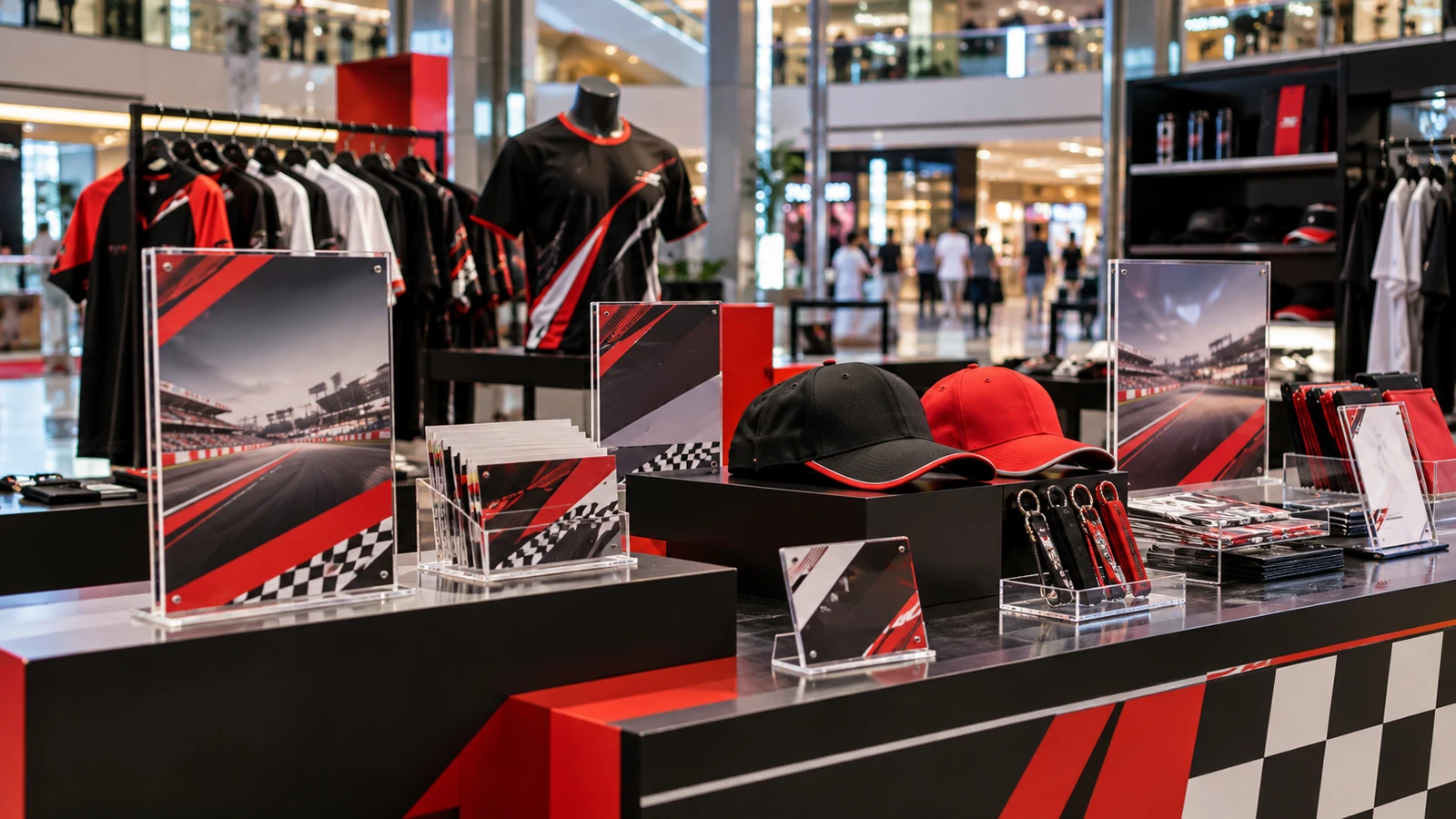
Short-duration retail changes the economics of print
A ten-day activation does not need every sign engineered for years of use. It does need fast replacement, clean presentation and enough durability to survive repeated customer handling. The official Singapore Tourism Board programme for Grand Prix Season Singapore 2026 runs from 2 to 11 October and includes motorsport pop-ups at Funan and Raffles City Shopping Centre, making short-lived retail a real current use case rather than an abstract example. For this kind of activation, the best system often combines reusable acrylic holders or small stands with printed inserts that can be replaced overnight. That keeps the visible counter tidy while allowing the content team to react to sold-out items, new arrivals or a revised offer. The print specification should match the campaign life, not a permanent-shop assumption.
Classify content by how quickly it can change
Create three groups before designing. Fixed content includes the core brand treatment and information that should remain stable for the entire activation. Semi-variable content includes product names, feature cards or category information that may change once or twice. Highly variable content includes price, stock messages, session timing and daily offers. Put the fastest-changing information on the smallest, easiest-to-replace card rather than embedding it in a large decorative panel. This reduces waste when only one line needs updating. It also lets staff replace one card without disturbing the rest of the counter arrangement.

Design the card for viewing distance and dwell time
A counter card is usually read from one to two metres while the shopper is already engaged with the product. That means it can carry slightly more detail than a corridor poster, but the headline still needs to be understood quickly. Use a clear hierarchy: product or offer first, one supporting point second, and small operational detail last. Avoid filling the entire card with tiny copy simply because the surface is available. If the card sits behind merchandise, raise the important content above the average product height. Test the display with the actual hats, bottles or folded apparel on the counter because empty-counter artwork approval hides real visibility problems.
Plan the holder and insert as two different assets
Acrylic holders, magnetic frames and tabletop stands can be reused, while the paper or synthetic insert carries the campaign-specific information. Record the exact insert size and orientation so replacement cards can be produced quickly without re-measuring the hardware. If staff change cards during opening hours, choose a holder that opens easily without tools and does not create sharp exposed edges. For outdoor or food-adjacent counters, moisture resistance may matter more than it does inside a mall. Standardising two or three insert sizes across the activation reduces the number of print files and spare holders required. The hardware becomes a small reusable system rather than one-off campaign waste.
Create a same-day correction path before launch
Temporary retail has little time to recover from a typo or price change. Keep the editable source files, identify who can approve a correction and decide where replacement cards will be printed if an issue appears after launch. A controlled naming convention such as date + location + card size + revision prevents staff from printing the wrong PDF. Keep a few blank or generic holders in reserve so an urgent card can be inserted without changing the counter structure. After each revision, remove the obsolete cards rather than leaving multiple versions in the back room. The operational value of short-run print is speed only when version control is equally fast.
| Content type | Best treatment | Reason |
|---|---|---|
| Core brand visual | Reusable holder or durable panel | Should survive the full activation |
| Product/category card | Replaceable insert | May change during campaign |
| Price/offer | Small short-run card | Highest change frequency |
| Daily schedule/availability | Quick-swap insert | Operational information can change fast |
Current Singapore reference
This article uses Singapore Tourism Board's current GPSS 2026 announcement as the factual local context. Read the official STB announcement.
Temporary retail works best when the display hardware is reusable but the information layer is deliberately easy to replace.
Frequently Asked Questions
Why reference GPSS 2026?+
STB confirms GPSS runs 2–11 October 2026 and includes current pop-up retail activations, making it a concrete example of short-duration physical retail.
Should price be printed on the main display?+
Only if it is unlikely to change. Variable prices are safer on smaller replaceable inserts.
Are acrylic holders better than laminated cards?+
They solve different problems. Holders are reusable structure; the insert can remain low-cost and replaceable.
Plan the Production Before You Order
If you are producing short-run retail cards, product cards or small point-of-sale inserts, standardise the holder sizes before sending the artwork to print.
Contact Us