

Heat-Press Logos on Lightweight Jackets: Buyer Checklist
Prepare branded lightweight jackets for heat transfer with the right logo size, fabric compatibility, placement, care instructions and test samples.
A lightweight jacket can be one of the most frequently worn pieces of a team uniform. That makes the logo important, but the shell fabric can be sensitive to temperature, pressure and surface coating. Treat jacket decoration as its own job rather than automatically applying the same settings used for a cotton T-shirt.
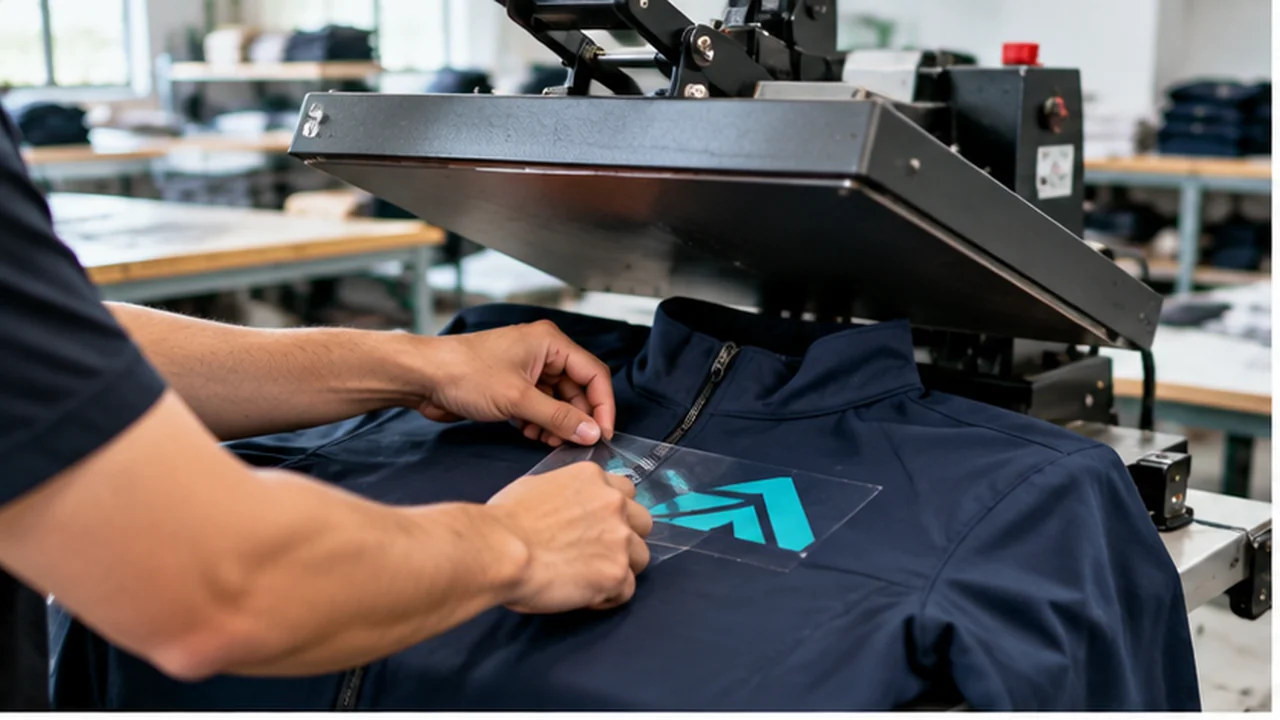
Identify the exact outer fabric
A woven polyester shell, a water-repellent coating and a soft-shell laminate can respond differently to heat. Product labels or a supplier’s technical specifications should be checked before selecting any transfer or adhesive. Ask the print provider to review the sample garment and any coating limitations.
Do not assume “heat press” means one universal process. Film, adhesive, pressure and application temperature vary; a small compatibility test can prevent visible marks or poor adhesion.
Select zones that survive everyday movement
Left chest logos are familiar, but jacket zips, seam allowances and pocket openings reduce usable flat space. Back logos may work for mobile teams, provided they do not cross heavily raised seams. A sleeve badge should be checked against elbow movement and garment folds.
Measure on an actual jacket in at least one smaller and one larger size. Keep a placement guide, especially if the size run includes very different body proportions.
Approve a test print and care note
Check colour, opacity, transfer edge, flexibility and whether fabric puckers near the applied area. Test the care instructions on the exact material; some coats or finishes require gentler treatment than ordinary shirts.
A transfer that looks flat immediately after pressing still needs review once the garment cools. A written proof protects both the buyer and production team from last-minute scale changes.
Coordinate jackets with the uniform range
Matching the shirt logo does not require matching the print dimensions. A jacket worn over layers may need a slightly different visual position. Keep one brand master and maintain a separate garment-specific production sheet.
If staff work across locations, pack jackets by size and department so distribution is easier, and record the transfer artwork version used for each run.
Quick comparison before placing an order
| Decision | What to consider | Approval check |
|---|---|---|
| Smooth chest panel | Common for subtle logos | Avoid zip line and pockets |
| Upper back | Visible when worn outdoors | Check vents and seams |
| Sleeve | Department mark | Test bending and sleeve folds |
How JCP services fit this order
For product specifications and appropriate customisation, review the relevant JCP product or service page. Its process and product examples can help you prepare a clearer quotation request. Availability, method, minimum quantity and delivery should be confirmed for your exact destination and order rather than assumed from a general guide.
See SingaporeUniform’s website for the destination brand and its current information. To share the final requirement directly with JC Print & Office, use the official JCP contact page. This article is informational and does not imply an operational Singapore or Sarawak showroom.
Frequently asked questions
Can heat press be used on any waterproof jacket?
No. Some coatings, membranes or treated materials can be damaged or resist adhesives. Confirm compatibility first.
Why does the print colour look different from the monitor?
Fabric shade, transfer material and device display settings can affect perception. Approve a physical sample where colour matching matters.
Is embroidery always safer?
Not necessarily. Needle holes may compromise some waterproof shells, so both decoration options require evaluation.
Illustrative AI-generated imagery. Service/product information cross-checked against publicly retrievable JCP pages on 21 October 2026. Images are local ZIP assets; live media URLs shown in HTML are placeholders until upload. Website domains shown above require site-side validation.