

Staff Name Badges: Pin, Magnetic or Embroidered Names?
Choose practical staff name badges by comparing pin and magnet fasteners with embroidered names, uniform fabrics and replacement needs.
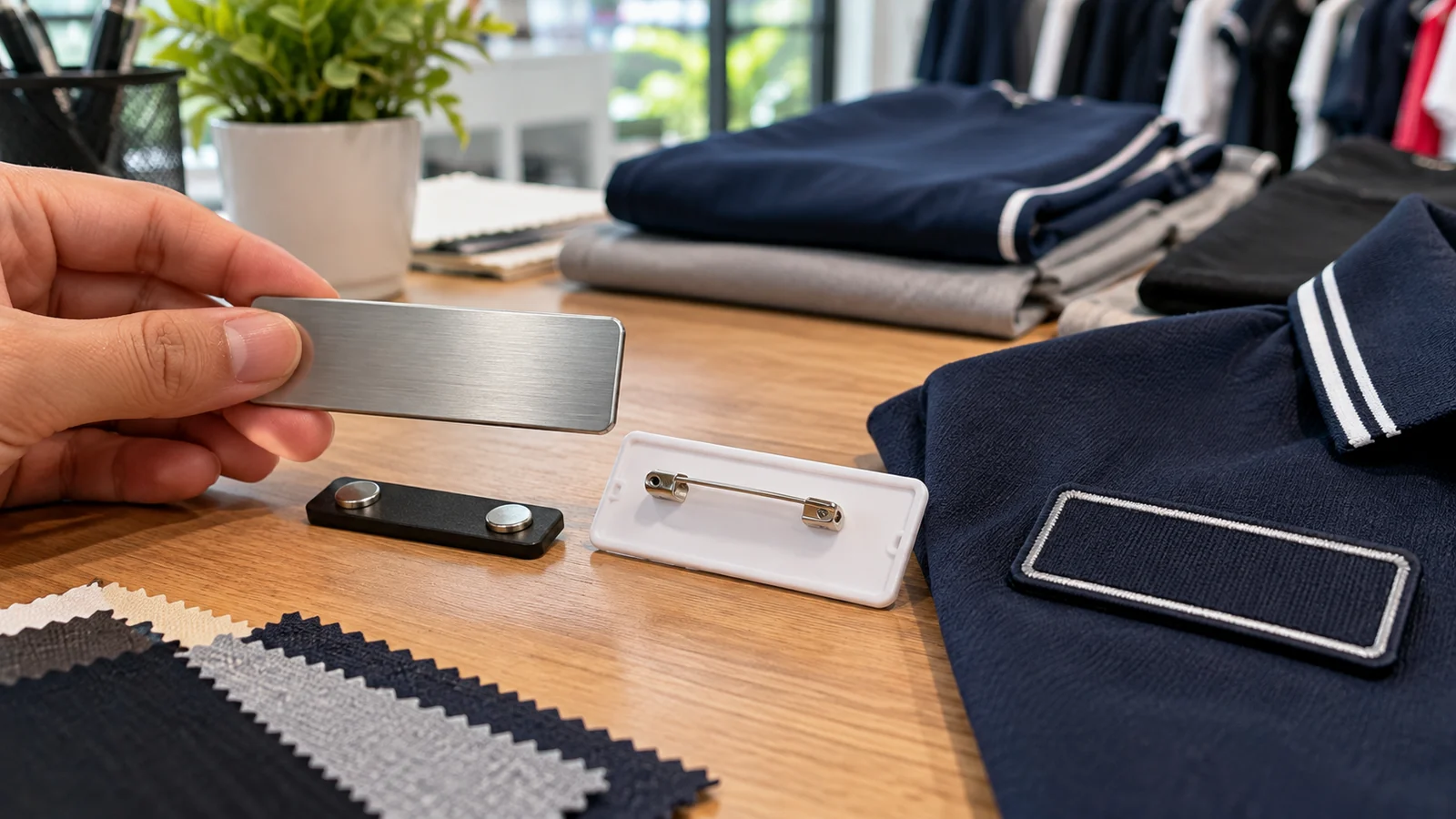
A staff name is a small detail, yet it affects how easily customers approach a team member and how confidently staff introduce themselves. When a Singapore business orders new uniforms, it is worth deciding whether names should be removable, attached as individual badges or stitched directly on the garment. The right answer depends less on appearance alone than on daily tasks, fabric construction and how often the team changes.
A removable badge makes role or name updates straightforward. Embroidery is more permanent and can feel integrated into a smart polo or work shirt. Before picking a finish, think about the uniform’s lifespan and whether a name is meant to identify a specific employee or a shared role such as supervisor, host or service crew.
Start with the way people work
A receptionist may spend most of the day speaking to visitors at eye level, so a clearly readable badge matters more than decorative detail. Restaurant teams often move quickly, lean over counters and wash garments frequently. Workshop employees may carry equipment close to the chest. These situations place very different demands on fasteners, lettering and surface durability; there is no universal best badge.
For organisations with high staff turnover or rotating shifts, a reusable nameplate can reduce the need to replace whole garments when responsibilities change. Where employees keep their own uniforms for a long time, stitched names can be appealing. Map those roles first and choose a consistent treatment for each group instead of ordering the same fastening system for everyone by habit.
Pin-backed badges: familiar and flexible
A pin-back badge is straightforward to remove, inexpensive to replace in principle and generally easy to position. It can work well on substantial woven shirts or sturdy outer layers. However, pins puncture fabric and may leave visible marks after repeated repositioning. Teams should check whether the fastener feels comfortable and stays secure when the wearer moves or carries bags.
Avoid putting the pin through a delicate lightweight knit without testing. A nameplate that looks stable on a sample shirt may droop or twist once worn for a full shift. Ask a colleague to put the uniform on, sit, bend and reach across a counter. Small fit checks usually reveal more than a flat photograph of the badge on a table.
Magnetic badges: neat but not automatically suitable
A magnetic backing can produce a clean appearance because no pin passes through the garment. It may be worth considering for front-desk and sales roles where shirts are frequently worn and washed. The holding strength depends on the fastener, badge weight and fabric thickness. A thick jacket layer or a heavy badge can make the attachment less secure than expected.
Magnets are not appropriate for every wearer or working environment. They may interfere with certain medical implants or sensitive equipment; follow workplace guidance and the relevant device manufacturer's advice. They can also be lost if staff remove a badge in a hurry. Test the exact backing and material combination and establish a simple storage process before standardising the order.
Embroidered names: permanent identification with a tailored look
Direct embroidery avoids separate fasteners and can sit neatly beside a corporate logo. It also changes the garment permanently, so a spelling error or a later name change may require replacement or a carefully planned repair. Small lettering needs enough space and stitch clarity. Curved seams, thick chest pockets and stretchy knits can make fine text harder to reproduce consistently.
When planning embroidery, ask for a proof showing the actual name size on the selected material, not only a large digital mockup. A name that reads beautifully on a computer screen may lose definition when stitched at a small scale. JCP’s embroidery service information gives useful context for comparing stitched apparel branding with other methods. Include one long and one short employee name in the sample approval.
Readability, placement and replacement planning
Most name badges work best when the letters are readable from a natural conversation distance and do not compete with a large company logo. Position should be consistent across men's and women's cuts, but a fixed distance measured from the shirt edge may not suit every fit. Check the logo, name, pocket and lanyard together on an actual wearer, particularly if staff also carry ID cards.
A practical name list should record spelling, preferred display name, role, badge type and replacement quantity. Keep approved artwork and colour specifications alongside it. You can browse uniform customisation services when choosing how badges, embroidered logos and shirts will work as one system; then use the Singapore Uniform site to continue the enquiry with a consistent brief.
What to send with the enquiry
- Headcount by role, including whether the uniforms are shared or individually issued.
- Exact spelling, capitalisation and any preferred job titles.
- Shirt fabric and colour, plus the badge position relative to the logo.
- Preferred attachment, likely replacement frequency and sample requirements.
- Any safety, equipment or workplace restrictions affecting fasteners.
How to evaluate the true cost per employee
Ordering cost is only one part of the decision. Include replacement after loss, damage to garments, new starter requirements and administration time. A removable badge can be transferred to another shirt, but the badge itself may be misplaced. Personalised embroidery eliminates daily attachment work yet ties the garment to one person. For a team with frequent staffing changes, model two or three realistic scenarios before declaring one route cheaper.
Imagine a service team of twenty employees with two uniforms each. If names are stitched on forty shirts, a new employee may require fresh garments. With removable badges, that change may involve only one new nameplate, provided an unpersonalised uniform in the correct size is available. Neither scenario guarantees a result, but it shows why procurement and replacement planning should be discussed together.
Approve a full uniform, not an isolated badge
Arrange a short fitting involving the name badge, company logo, ID lanyard and any apron or outerwear. Take a front-view reference photo for internal approval, then check readability under normal indoor lighting. Names should look consistent without making small text artificially cramped. Confirm whether staff themselves can attach and remove badges correctly, and document the position in a simple one-page instruction.
For the final proof, ask the supplier to show one of the longest names as well as a common short name. A spelling and character checklist is particularly important where employees use preferred names or multiple languages. Store approved sample photographs with the final order list. That record will help new supervisors repeat the look without measuring everything from memory.
Common questions
Can a badge be moved between shirts?
Removable badges can generally be moved, but secure fit should be checked on every fabric type. A pin that works on woven cotton may behave differently on a loose performance knit, while magnetic attachments need suitable material thickness.
Should every employee have the same badge size?
Keeping a common outer size supports consistency, but long names may need adjusted typography. Avoid shrinking the longest names until they become difficult to read; check a full-size proof before production.
Is embroidery always more durable?
Good embroidery can be durable, but garment construction and care still matter. Embroidery is not removable, and replacement becomes more involved if someone changes roles. Compare total ownership needs rather than just surface wear.