

Uniform Types
Front-Desk Corporate Shirts: Choosing Pockets, Plackets and a Reliable Tuck Length
A smart shirt that looks good on a mannequin can still fail during a full shift: the hem escapes when someone reaches across a counter, a chest pocket bulges with pens, or the collar softens after repeated washing. The right specification starts with actual work tasks and a representative fit sample, not a colour swatch alone.
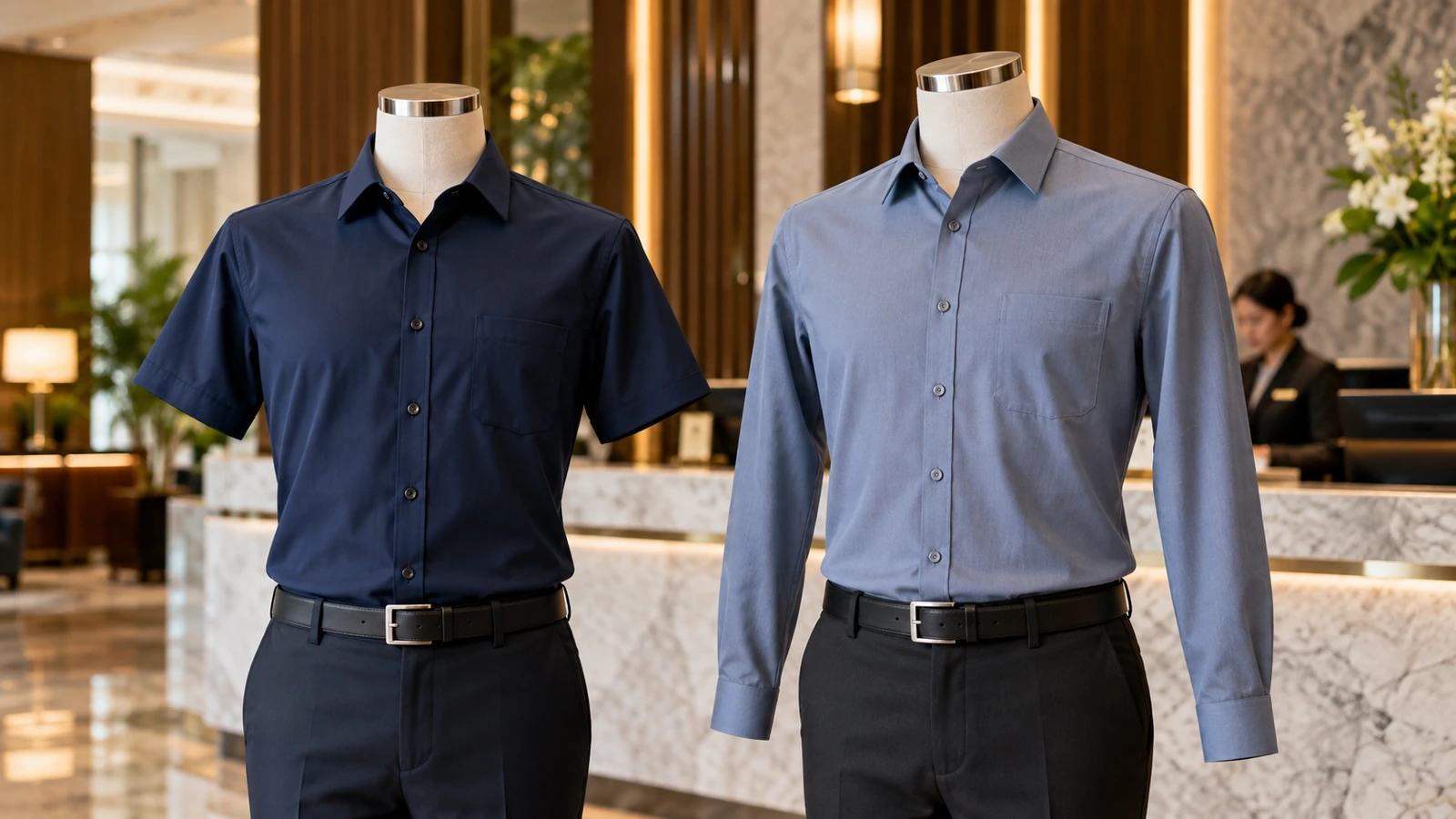
Start with the front-desk tasks, not only the dress code
Make a short list of what employees actually do: standing at a counter, reaching for paperwork, bending to retrieve supplies, walking between departments and using a tablet or scanner. A uniform that restricts shoulder movement makes even routine work uncomfortable. Ask each role whether the shirt must remain tucked and whether staff carry pens, radio clips or a name badge. Those answers affect pattern and pocket decisions more directly than photographs of formal outfits.
Observe how existing shirts behave at the busiest times. If the hem repeatedly pulls out, investigate length and armhole ease rather than simply issuing a larger size. Extra width can look untidy without solving the reach problem. A practical brief records the working posture, degree of formality, climate, laundering frequency and preferred sleeve length. It allows the supplier to recommend a suitable ready-made model or a cut-and-sew adjustment.
Choose a pocket for its purpose, not as decoration
A chest pocket can be useful for a single pen or access card, but it can also interrupt a logo placement or create a lumpy outline. For teams using clip-on name badges, specify where the badge will attach and whether the pocket edge is reinforced. If staff do not need a pocket, a plain chest panel usually gives the neatest uninterrupted surface for subtle branding. Avoid automatically copying the pocket location from a fashion shirt without considering daily equipment.
Test a physical sample with the actual items employees carry. A wide pocket may look balanced when empty but sag under a phone; a shallow pocket may allow pens to fall out. With embroidery, keep the stitch field clear of pocket seams and thick folds. Ask the maker to confirm the practical decoration area before finalising a small chest logo, especially when pocket shape changes across sizes.
Evaluate placket structure and button spacing
The front placket is a narrow construction detail with a large visual effect. A well-made placket lies flat without twisting, while irregular button spacing can cause gaping when staff reach forward. Compare a conventional button placket with a concealed-button treatment when a more minimalist appearance is desired. Neither construction is automatically better: more complicated finishing can add production decisions and should be supported by a physical approved sample.
Check placket alignment while the wearer sits, stands and stretches the arms. The fabric should not pull sharply across the chest or cause the top buttons to strain. A concealed placket also needs to be checked after laundering, when pressing can become more demanding. If an ID lanyard crosses the front, verify that it does not catch on exposed buttons or pull the collar open.
Specify tuck length and hem shape together
A tucked shirt needs sufficient length to stay inside the waistband during normal arm movement. An untucked shirt needs a deliberate finished length so it does not resemble an oversized formal shirt. Curved shirt tails may support a tucked style but can look uneven when worn loose; a straighter hem can appear cleaner on an untucked design. Decide this before approving the size chart because the correct body length depends on the intended styling.
During fitting, ask staff to raise their arms, reach across a counter and sit down. Look at the longest and shortest torso lengths within the team. A single sample size cannot prove the range will fit equally well. If a supplier offers graded sizes, confirm whether hem length and chest width change proportionally. Record the exact style code for later replacements instead of assuming that a generic medium will match.
Balance fabric feel, opacity and crease recovery
For air-conditioned reception areas, breathable cotton-rich and blended shirting can both work, but the trade-off is different. Cotton-rich cloth may feel pleasant next to skin yet can crease and require careful ironing. A polyester blend may dry faster and retain a flatter appearance but can feel less comfortable to some wearers. Examine the actual weave, weight and finish rather than judging only by fibre percentages on a catalogue page.
Hold light-coloured fabric against contrasting backgrounds to check opacity, then wear a sample under the real office lighting. Check whether the collar and cuffs lose shape after a wash. If your team sends shirts to a shared laundry, include pressing instructions in the uniform handover. The best fabric is one the staff can maintain consistently, not merely the smoothest-looking fabric on day one.
Approve a sample with logo placement and full movement
A useful approval sample includes the intended colour, chosen shirt construction, proposed logo method and the final pocket arrangement. Photograph it from the front, side and back in normal standing posture. Then ask several employees to complete a short movement test. Note any pulling at the button line, sleeve restriction, pocket interference, collar roll or hem movement. Small changes before bulk production can prevent widespread dissatisfaction later.
JCP lists corporate uniforms and garment customisation among its apparel services, including options such as embroidery and cut-and-sew production. Treat that capability as a starting point for a quotation, not proof that any specific collar or pocket option is available without checking. Provide a concise specification sheet with the approved sample, size totals, artwork dimensions, logo position and maintenance expectations. This gives production a single reference.
Frequently asked questions
Is a chest pocket necessary on a reception uniform?
No. Include one only where staff need it for a defined task or where it is an intentional design choice. A plain front may look cleaner and simplify small-logo placement.
Should all front-desk shirts be tucked in?
Not automatically. Decide by brand presentation and job movement, then choose a hem designed for that styling. A tucked and untucked shirt often need different length priorities.
Can the same shirt fit every staff role?
A common style can work, but representative fit samples across different builds are important. Record approved sizes rather than assuming one manufacturer’s sizing convention applies universally.
What should be approved before bulk embroidery?
Approve the physical garment, pocket location, stitch field, logo dimension, colour and at least one stitched sample on the actual material.
Before you approve the order
The final order sheet should identify the exact garment model, colour, size range, pocket choice, placket treatment, logo method and hem styling. Keep photographs of the fitted sample with that record so later reorders are consistent. If employees disagree about a feature, return to the work requirement rather than trying to solve every preference with one oversized or heavily customised shirt.