

Honeycomb Polo Shirts: What the Knit, Collar and Weight Really Mean
Understand honeycomb polo texture, fabric weight, collar structure and logo decoration before buying work uniforms.
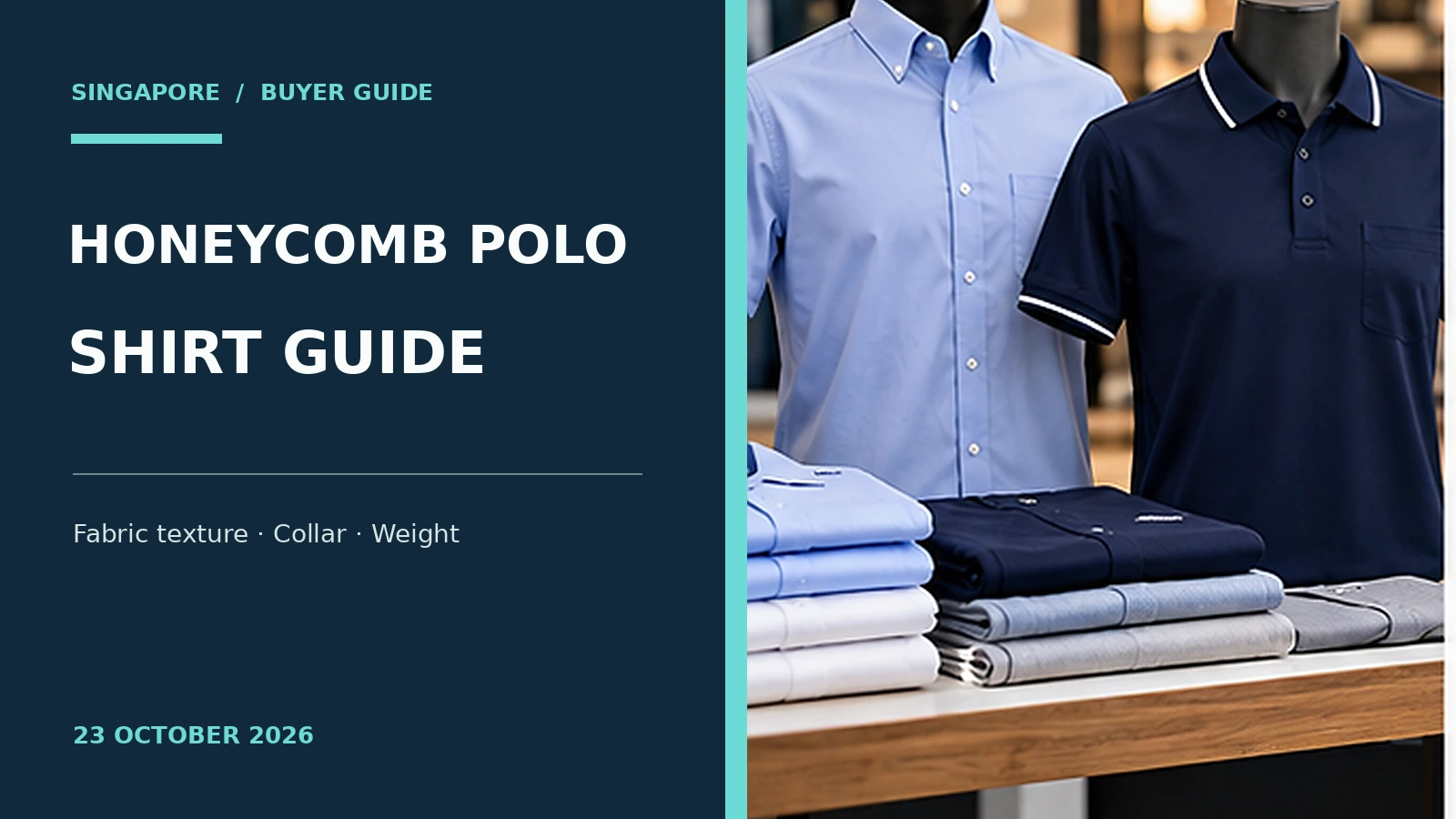
A textured polo can look more substantial than a smooth jersey polo, but texture alone says little about comfort or longevity. Honeycomb knits are common in staff apparel because they produce a distinctive surface. Buyers should still consider fibre blend, fabric mass, collar recovery and how a stitched or printed logo sits on the knit.
The point of a good uniform specification is to reduce uncertainty for buyers and make daily wear comfortable for the people who receive it. Compare samples in the workplace, and separate requirements that are essential from preferences that can change. Clear documentation helps prevent a beautiful mockup from becoming an inconsistent or difficult-to-reorder product.
Understand knit texture rather than marketing labels
“Honeycomb” describes a visible knit structure, not one universal recipe. Two polos with a similar pattern can vary in cotton content, polyester content, softness and stretch. The texture may appear strongly on some shirts and subtly on others. Rather than relying on a style name, inspect a fabric swatch in daylight and compare the actual sample with a smooth-knit alternative.
A supplier listing such as the Oren Sport HC01 honeycomb polo provides an example of a documented composition and garment weight. Those figures relate to that model, not every honeycomb polo. Use the listing to form questions about the material, then verify the specific item you intend to order.
Put fabric weight into context
GSM measures fabric mass per area, not automatic quality. A heavier knit can feel substantial and retain a structured appearance, but it may also feel warmer in certain workplaces. A light knit may dry faster or drape differently. Compare garments in the conditions where employees work, particularly in warm rooms or shifts involving movement.
Do not choose a product purely because it has the highest GSM on a quotation. Hold both samples up to the light, feel the drape and ask staff how the material performs after a normal shift. Also check whether the fabric becomes see-through in lighter colours.
Inspect the collar and placket
A polo collar frames the face and carries much of the garment’s professional appearance. A collar that curls after washing can make a new uniform look tired quickly. Look at the collar edge, the attachment stitching and how the placket lies flat. Button spacing and reinforcement also affect how easy the shirt is to wear.
Try fastening and unfastening the placket repeatedly. If there is a contrast trim or stripe, check that it aligns neatly at the centre front. Small defects become more noticeable when an entire department wears the same style in a group photograph.
Check decoration on a textured surface
A densely stitched logo can sit neatly on a stable polo, while fine print detail may interact with the uneven surface of the knit. Embroidery needs appropriate backing and a suitable stitch density so that fabric does not ripple. Other methods must be chosen for the fabric and desired artwork, not merely because they are familiar.
Ask for a decorated physical sample on the exact colour and model. The uniform embroidery service is one route to examine for a restrained chest logo; compare it with printing if the design relies on gradients or very small lettering.
Use colour consistency as an ordering control
Polos may be available in many shades, but colour names are not industry-wide standards. One manufacturer’s navy may look greener or darker than another’s. Compare swatches under daylight and the lighting used in the workplace. Different fabric blends may take dyes differently even when the product images appear identical.
Record model codes, colour codes and dates of approval. If several branches order independently, give them the same specification sheet. When stock is unavailable, require a side-by-side sample of the proposed substitute so the team does not end up wearing visibly different blues.
Test laundering and staff comfort
A uniform polo needs to survive a repeated use-and-wash cycle, not just look attractive on a hanger. Check collar recovery, pilling, body length, seam twist and how the logo behaves after washing. Staff who work in a warm environment may value breathability more than a heavy texture, while a front-desk team may prioritise a neat structured finish.
Run a small wear trial with at least two body types and one washed sample. Note any complaints about rubbing near the collar or underarms. Such feedback is cheaper to act on before production than after hundreds of pieces are decorated.
Four details to confirm before ordering
| Item to check | Why it matters |
|---|---|
| Knit, fibre and GSM | Agree on the final specification and check a physical sample where practical. |
| Collar recovery | Agree on the final specification and check a physical sample where practical. |
| Decoration sample | Agree on the final specification and check a physical sample where practical. |
| Colour code and repeatability | Agree on the final specification and check a physical sample where practical. |
For a quotation, prepare the intended quantity, preferred size or format, available artwork, colour direction and expected date of use. Ask the supplier to identify which decisions are fixed and which are still assumptions. Where a sample is needed, plan enough time to review it before final approval instead of compressing all checks into the final production week.
Frequently asked questions
Is honeycomb the same as pique?
The terms are sometimes used loosely; compare the actual knit pattern and specification.
Does a heavier polo last longer?
Not necessarily. Yarn quality, construction, care and working conditions matter too.
Can embroidery look uneven on textured fabric?
It can if backing or stitch design is not suited to the knit. A sample is recommended.
Make the next order easier
If you are comparing options for an upcoming order, review the available garments and product styles alongside the relevant service information, then request a specification-based quotation. A shortlist supported by samples will usually lead to a better outcome than ordering solely from a catalogue image. For more uniform buying advice, you can also browse SingaporeUniform.com.