

DTF vs Silkscreen for Printed Team T-Shirts
Compare direct-to-film and silkscreen printing for company T-shirts by artwork, quantity, fabric, print feel and repeat orders.
A shirt can be inexpensive yet a poor choice if the print feels uncomfortable, colours vary between deliveries or the design changes after approval. For business T-shirts, DTF (direct-to-film) and silkscreen solve different problems. The useful question is not which method sounds more advanced; it is which one fits your artwork, garment and expected repeat quantity.
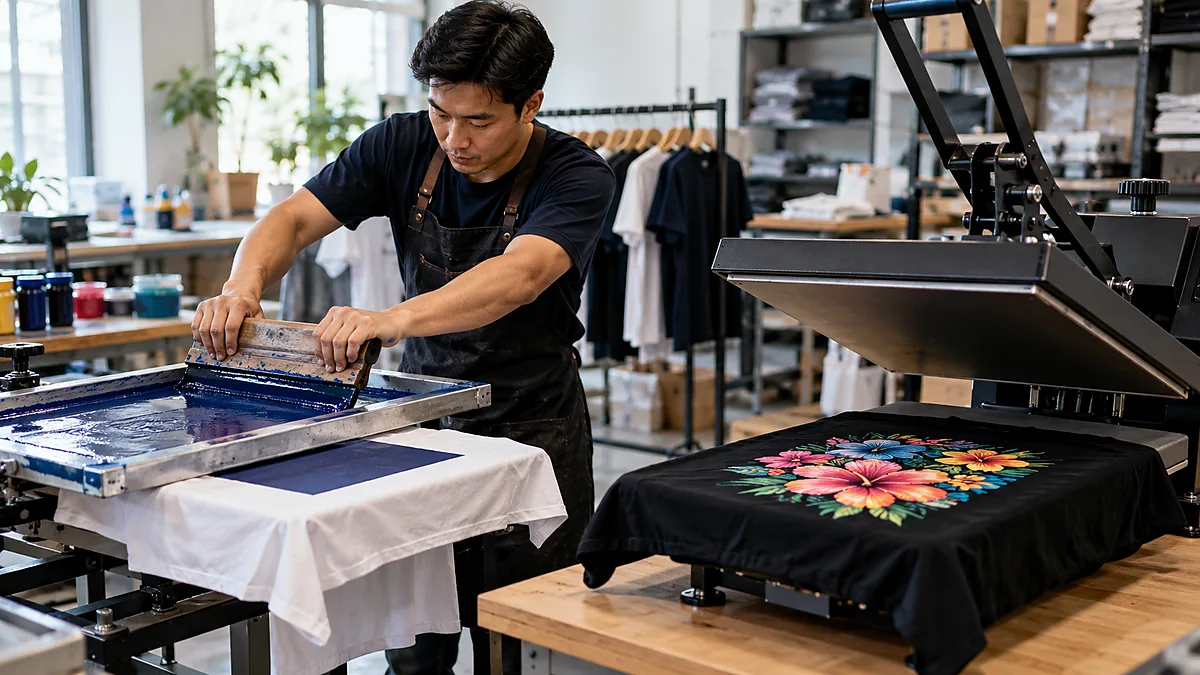
Begin with the artwork and the size of the order
Silkscreen uses prepared screens to apply selected ink colours. It is often attractive when many shirts carry the same simple graphic, because setup effort can be spread across a larger order. DTF uses a printed transfer that is applied to a compatible garment using heat and pressure. Its ability to handle complex multi-colour artwork is useful when a customer wants detailed logos or a shorter production run.
That does not mean DTF is automatically cheaper for every small order or that silkscreen is always superior for large ones. Print area, number of colours, shirt type and production setup all matter. Share the actual file and quantities with your supplier before drawing conclusions from a generic per-piece price.
Compare how the finished print feels
For a large solid image on the chest, the print’s hand-feel matters almost as much as its appearance. A thick, broad transfer may feel noticeable on a lightweight tee. Silkscreen can also feel substantial if a heavy ink deposit is used. On the other hand, a compact left-chest design can be comfortable in either method when properly specified. Ask about the recommended print width and the finished surface, not just whether the logo can be reproduced.
The fabric also affects the decision. Cotton, performance polyester and blended materials respond differently to production heat, inks and washing. An operator should confirm compatibility with the selected shirt, especially for heat-sensitive performance fabric or a dark garment requiring an underbase.
Look at artwork details before sending a purchase order
Very small letters, hairline outlines and delicate gradients should be assessed at actual production size. A logo that is crisp on a large monitor may become difficult to read on a 7 cm chest print. Supply vector artwork where available; otherwise provide a high-quality transparent file and confirm whether the supplier needs to redraw or simplify it.
Decide whether your team needs the same artwork on every shirt, or whether names and departments change. Individual names are usually easier to plan using a suitable transfer workflow than repeating a separate silkscreen setup for each person. Confirm personalisation separately from the standard logo price.
A practical decision matrix
| Requirement | Usually worth comparing first | Check before approval |
|---|---|---|
| Large repeat order with a simple mark | Silkscreen | Screen setup and number of colours |
| Detailed full-colour artwork | DTF | Print dimensions and hand-feel |
| Each wearer has a different name | Transfer-based personalisation | Name list, spelling and placement |
| Regular replenishment of one design | Either, based on repeat quantity | Retained art, garment code and colour |
Confirm a real production specification
Agree on the garment code, colour, size counts, artwork version, positions and dimensions. Review the design against a physical size sample, particularly when the team spans XS to larger sizes. Ask for the care instructions appropriate to the chosen print and fabric. A repeatable order sheet prevents a future reorder from relying on someone’s memory of how the first run looked.
For a complete ordering discussion, review the JCP method-and-material comparison and the SingaporeUniform website. The supplier can then quote a method appropriate to the specific artwork rather than a one-size-fits-all package.
Frequently asked questions
Does DTF mean a shirt is fully sublimated?
No. DTF is a heat-applied transfer process; sublimation is a different method usually used on suitable polyester materials.
Can the same shirt design be printed using both methods?
Sometimes, but the artwork, finish and costs can differ. Request a sample or proof of the chosen method.
More on JCP services: JCP production methods and material guide. Specific fabric, sizing, stock and lead-time recommendations should be confirmed for your order.