

Planning Sticker Labels for Prepacked Food After Singapore’s 2026 Labelling Changes
Singapore’s amended requirements for prepacked food took effect on 30 January 2026. For businesses using printed stickers or over-labels, the operational challenge is to fit approved mandatory information into a label that remains legible, firmly attached and manageable across product variants.
In This Article
Direct Answer
Treat compliance content as a locked information layer before styling the label. SFA states that prepacked food sold in Singapore must meet the Food Regulations, and its 2026 guidance allows sticker labels to add mandatory information when they remain firmly attached and do not cover other required information. Printing decisions should follow the approved content, not substitute for regulatory review.

Separate regulatory approval from print production
The first production rule is simple: a printer should not be expected to decide whether food claims or ingredient declarations are legally correct. The Singapore Food Agency states that all prepacked food offered for sale in Singapore must comply with the Food Regulations and labelling requirements. The Food (Amendment) Regulations 2025 came into operation on 30 January 2026, so current artwork should be checked against the current requirements rather than an old label file.
Build the workflow in two gates. Gate one is content: product name, ingredient statement, net quantity, local business details, origin information where applicable, warnings and any other required declarations are reviewed by the responsible food business or qualified adviser. Gate two is production: once the content is approved, the label is sized, proofed and printed. This separation prevents a common failure in which a visually finished label is printed in volume before a compliance correction forces rework.
Use sticker overlays deliberately, not as emergency patches
SFA’s published guidance notes that sticker labels may be used to incorporate mandatory information, provided the sticker stays firmly attached and does not cover other essential information required by the Food Regulations. That makes over-labelling a legitimate operational tool for some imported products, short runs or transitional packaging. It does not mean any small sticker placed anywhere will work.
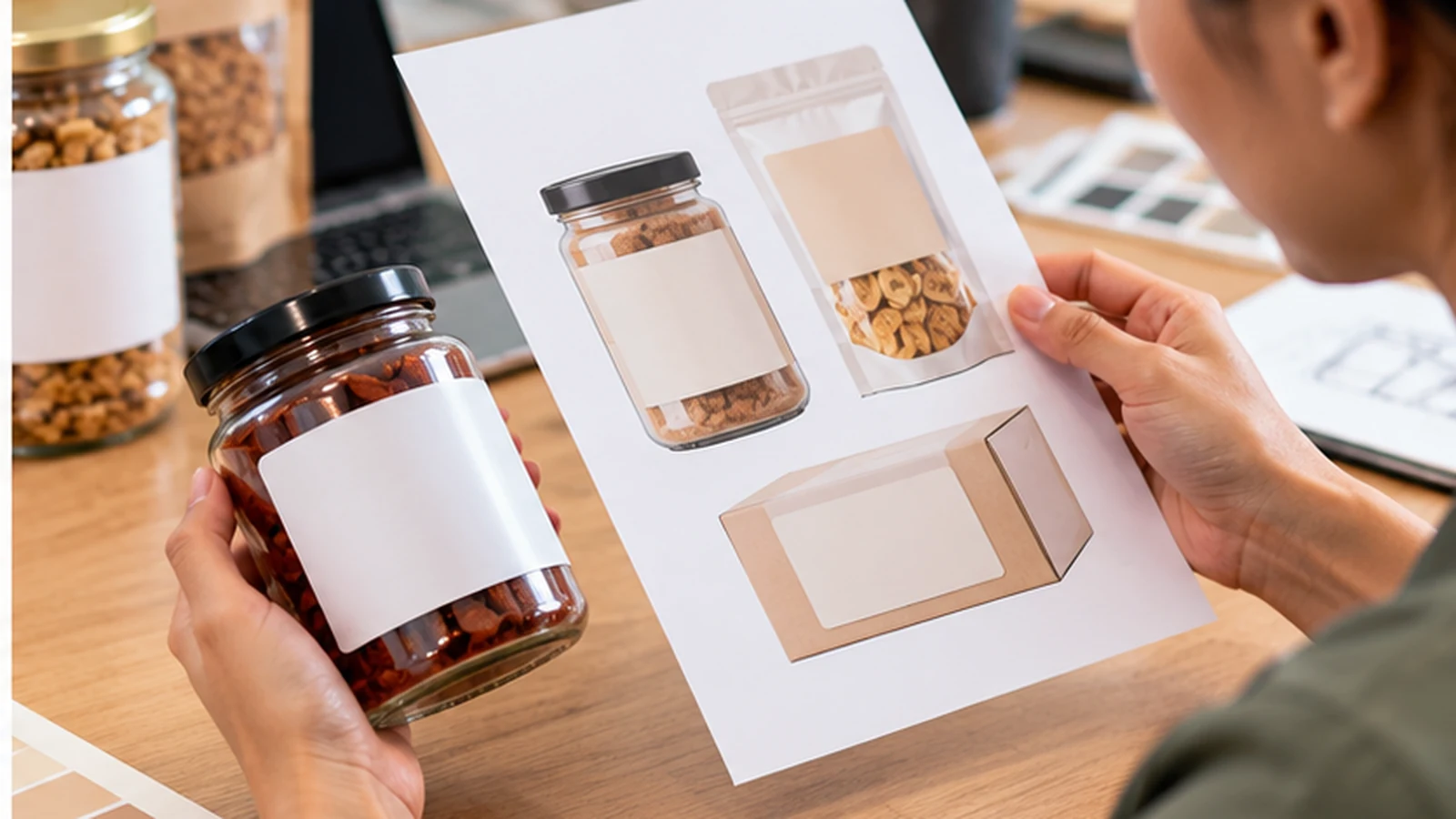
Measure the actual pack, including curves, seams, condensation zones and areas handled by customers. A label that fits a flat artwork template may wrinkle around a jar shoulder or lift from a chilled container. Keep a clear map of which original information must remain visible beneath or beside the sticker. If the sticker is being used for a regulatory correction, approve the physical applied sample—not just the PDF—before releasing the quantity.
Design for version control when information changes
Food labels contain more variable information than many marketing stickers. Ingredients can change, importer details can change, pack sizes can change, and different flavours may require different declarations. A visually similar label can therefore be the wrong label. Give each approved artwork a revision code and date in the production file name, even if that code is not printed on the consumer-facing design.
For example, a business with six flavours and two pack sizes already has twelve label variants. If each is ordered in 2,000 pieces, a single obsolete file can create 2,000 unusable labels. A simple release sheet listing SKU, label size, artwork revision, quantity and approval owner reduces that risk. Archive superseded files in a separate folder rather than leaving them beside the current artwork with names such as “final2” and “final-new”.
| Decision | What to verify | Why it matters | Owner |
|---|---|---|---|
| Content release | Current mandatory information and claims | Avoid printing obsolete or unapproved content | Food business/compliance owner |
| Physical size | Real pack dimensions and clear area | Prevents overlap and wrinkles | Packaging/production |
| Material | Surface, moisture, temperature, handling | Controls adhesion and durability | Printer + product team |
| Version | SKU, revision, quantity, approval date | Stops old artwork from being reordered | Procurement/marketing |
Choose material around the package environment
Adhesive and face material should match the package, not just the visual style. Dry paperboard stored at room temperature is relatively forgiving. Refrigerated jars, chilled cups and flexible pouches introduce moisture, low temperatures, curves and movement. Those conditions can expose weak adhesive choices or cause paper labels to soften.
Test labels on filled packages under realistic storage conditions. Apply them using the same surface-cleaning and handling process staff will use in production, then check edge lift, wrinkling, scuffing and readability after storage. If a product moves from ambient display to refrigeration, test both states. Print quality is only useful when the label remains attached and legible through the product’s actual journey.
Current Singapore reference point
Current Singapore references: Singapore Food Agency’s Labelling Requirements for Food and its published guidance on the Food (Amendment) Regulations 2025. Regulatory requirements should be checked again when artwork is released because rules and product circumstances can change.
For food labels, the safest print workflow locks approved information first, proves the label on the real package second, and only then releases volume.
Frequently Asked Questions
Did Singapore’s amended prepacked-food labelling rules take effect in 2026?+
Yes. SFA states that the Food (Amendment) Regulations 2025 came into operation on 30 January 2026.
Can sticker labels be used to add mandatory information?+
SFA guidance says they can, provided the sticker remains firmly attached and does not cover other essential required information.
Can a printer approve food-label compliance?+
Printing production and regulatory review are different responsibilities. Businesses should verify current requirements with SFA or an appropriate labelling adviser.
Need approved label artwork turned into production stickers?
JCP can help with sticker and label printing once your product information, dimensions and artwork version are confirmed.
Discuss Sticker Printing