

How to Build a Uniform Issue-and-Return System for Staff Turnover
Most uniform waste does not start with bad fabric. It starts with weak records: nobody knows who received what, which pieces can be reused, which sizes are running low, or what should happen when someone resigns.
In This Article
Direct Answer
Treat uniforms like managed stock, not one-way giveaways. Record what is issued, separate reusable from personalised garments, define return condition grades, and decide what happens to each returned piece before the first employee leaves.
A simple system can work for a five-person shop or a multi-site team. The important part is that the rules are written down and used consistently.

1. Give Every Uniform Style a Simple Internal Code
Do not begin with employee names. Begin with the garment specification. For example, a navy short-sleeve polo with left-chest embroidery might be coded internally as POLO-NVY-EMB-A. A grey operations shirt can have a different code.
The code lets purchasing, HR and operations talk about the same item without relying on photos or memory. Keep the supplier model, garment colour, decoration method and approved artwork linked to that code.
This is especially useful when staff work across several Singapore locations. A team in Raffles Place and another team elsewhere can reorder the same approved item instead of slowly creating two versions of the uniform.
2. Record the Issue — but Only the Information You Need
A practical issue register needs the employee or staff identifier, garment code, size, quantity and issue date. If individual garments are expensive or specialised, add a unique garment number. For ordinary polos, quantity-by-size is often enough.
Do not overengineer the system. The goal is to answer three questions quickly: What does this person currently hold? What stock do we have left? What must be recovered when the role ends?
| Return Grade | Condition | Recommended Action |
|---|---|---|
| Grade A | Cleanable, no visible damage, branding still presentable | Launder, inspect and return to active stock |
| Grade B | Minor fading, small repairable issue, still functional | Repair, keep as backup or training stock |
| Grade C | Permanent stain, damage, badly faded or unsuitable | Remove from active stock; recycle/dispose appropriately |
| Personalised | Usable but permanently assigned to one person | Keep separate; assess whether de-personalisation is practical |
3. Grade Returned Garments Instead of Making a Yes/No Decision
Returned apparel is rarely only “good” or “bad”. Use three grades. Grade A is clean, presentable and ready to reissue after laundering. Grade B has minor wear and may be suitable for backup, training or repair. Grade C is no longer suitable for staff use and should leave active stock.
Define the standard before returns arrive. If different managers make the decision by instinct, one branch may reissue a shirt that another branch would discard.
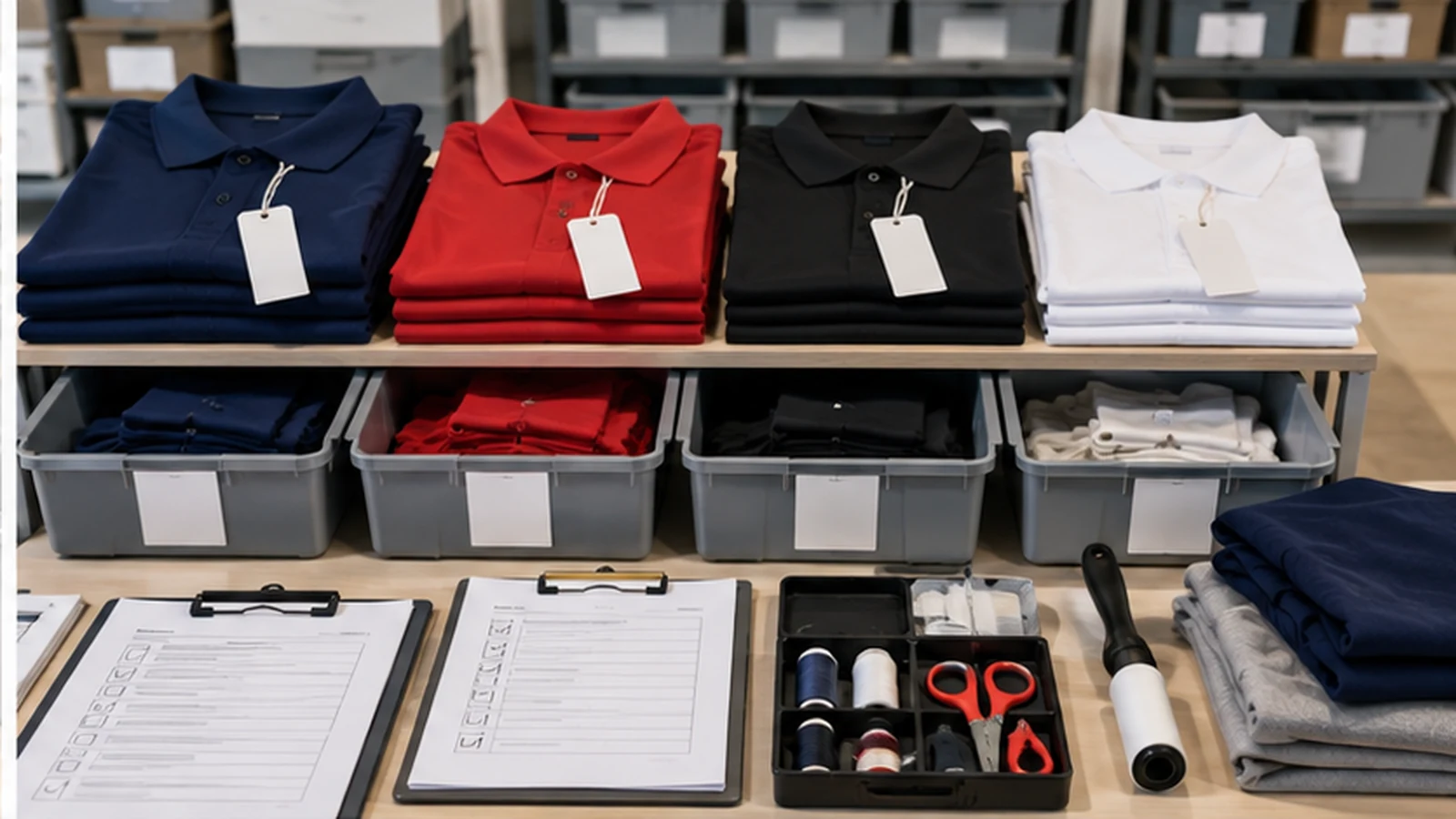
4. Keep Personalised Garments Out of General Reusable Stock
Permanent staff names, role titles or unique numbers reduce reuse because the next wearer may not match the personalisation. Store them separately from generic stock and decide whether removal or re-decoration is technically and economically sensible.
This is where uniform design affects operations. If turnover is high, generic branded garments plus removable name badges can preserve far more reuse flexibility than permanently personalising every shirt.
5. Use Returns to Improve the Next Order
Every return tells you something. If one size is constantly missing, your size buffer is wrong. If collars fail before the body fabric, the garment choice may need review. If large quantities are never returned, the issue policy may be unclear.
Review the register before each reorder. The size distribution of real staff, the number of reusable returns and the quantity of damaged garments are better planning inputs than a fresh guess every time.
A Good System Makes Reordering Easier
The best outcome is not simply recovering shirts. It is creating a reliable loop: issue, use, return, grade, clean, reissue or retire. Once that loop exists, purchasing becomes more predictable and fewer usable garments disappear into cupboards or homes.
Uniform control becomes much easier when the business manages garments as a reusable system rather than treating every issue as a brand-new purchase.
Frequently Asked Questions
Should employees be required to return uniforms?+
That depends on company policy and employment arrangements, but the return expectation should be communicated clearly before garments are issued.
Do we need to track every shirt individually?+
Usually not for standard low-cost polos. Individual tracking is more useful for expensive, specialised or controlled garments.
How much spare stock should we hold?+
Use actual hiring and size history. A small buffer of common sizes is usually more useful than keeping equal quantities of every size.
Reviewing Your Uniform System?
If the issue-and-return process shows that your garment mix, sizing or branding needs an update, JCP can support corporate apparel supply and customisation for repeatable staff programmes.
Discuss Your Uniform Requirements